Introducing ambient agents in Insights

Today we’re launching ambient agents on the Telescope platform. Ambient agents monitor markets, instruments, and portfolios, and alert when something is relevant to the investor or trader receiving it.
An ambient agent subscribes to a scope — a single instrument across any exchange and asset class, an entire market like the FTSE 100 or S&P 500, or a personal investment portfolio — and continuously evaluates relevance. It keeps track of what it has already seen, its reasoning over time, and what the user has already been alerted about. When an event crosses the relevance threshold, the agent delivers a concise explanation of what happened and why it matters. When nothing crosses that bar, it stays silent.
On the Telescope platform, you can create ambient agents using the following API calls:
telescope.subscribe("/insights/instrument", "{any-instrument}", "{personality}")
telescope.subscribe("/insights/market", "{any-market}", "{personality}")
telescope.subscribe("/insights/portfolio", "{portfolio-id}", "{personality}")
What alerts look like
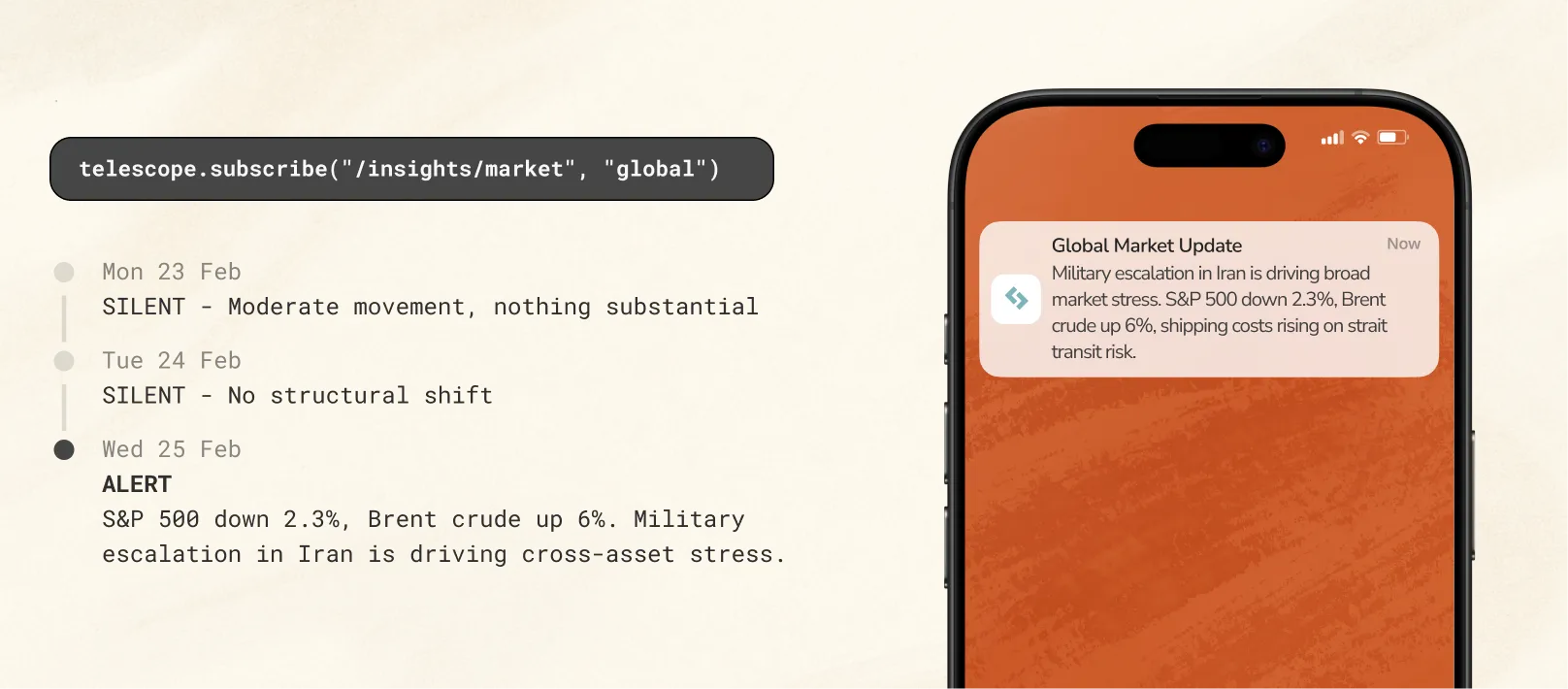
A market-level agent monitors conditions across asset classes and geographies. Say tensions escalate in a major shipping corridor. Rather than surfacing every headline, the agent connects the dots — rising energy futures, climbing shipping risk premiums, downstream pressure on transport-sensitive sectors — and delivers one notification explaining the transmission path.
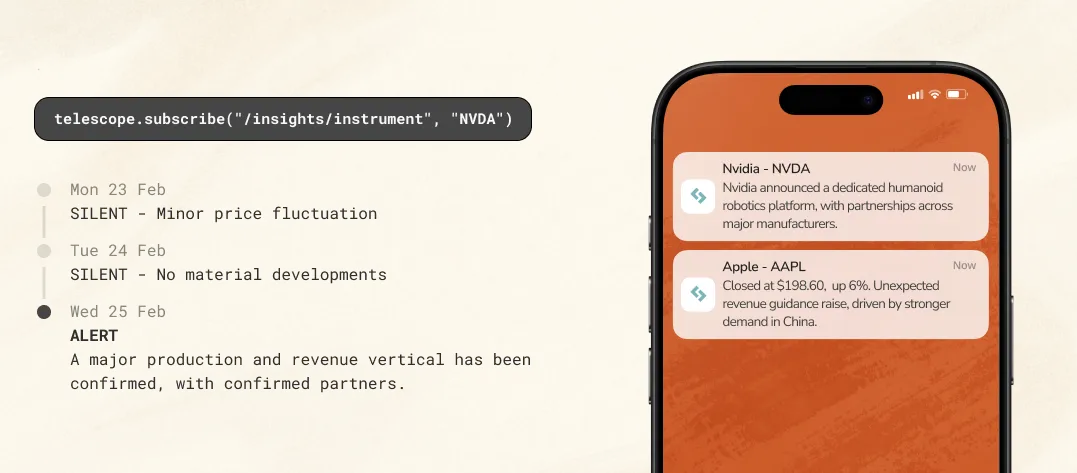
An instrument-level agent subscribes to a single security and watches everything around it. Most days, nothing happens worth reporting — minor price movements, in-line earnings, routine analyst commentary. The agent stays silent through all of it. Weeks might pass without a single alert. Then the company announces a major acquisition, or reports earnings that diverge materially from consensus. The agent triggers, identifies the dominant driver of the repricing, and explains why this event is different from the noise it has been filtering.
A portfolio-level agent evaluates events against the user’s holdings. When a central bank announces an unexpected rate decision, it identifies which position in the portfolio is most exposed and explains the chain from policy move to portfolio impact.
In each case, behavior is determined by scope, threshold, and audience segment configuration.
”The real challenge was not getting LLMs to talk. It was getting them to stay silent until something actually mattered.” Luc Pettett, Founder & CEO, Telescope
Configurable at every level
Ambient agents are designed to embed into any broker platform, advisory workflow, or investor-facing product.
Scope determines what the agent watches. It can cover a single instrument, a thematic or geographic market view, or an entire client portfolio. Scopes compose, so platforms can run multiple agents and deduplicate alerts across levels.
Threshold and cooldown control selectivity. Partners set the relevance bar and minimum interval between alerts. During high-volume periods — earnings, policy decisions, geopolitical events — the system remains selective instead of flooding channels.
Audience segmentation allows different behavior for different user types. A retail investor may receive one consolidated daily alert in volatile conditions, while a portfolio manager receives position-level updates. The platform defines segments; agents enforce them.
Built for platforms
Broker platforms and financial advisories deal with large volumes of market information by default. In internal testing across three global broker platforms, a single instrument — Nvidia — generated an average of 27 news stories in a 24-hour earnings window. Most investor-facing products remain feed-driven, with relevance left to the user. Ambient agents invert that model: high thresholds, low frequency, and explicit rationale attached to every alert.
For broker platforms, this improves attention economics rather than increasing content volume. For advisories, it enables scalable portfolio monitoring without additional operational load. For investors, it reduces noise and accelerates understanding of relevant events.